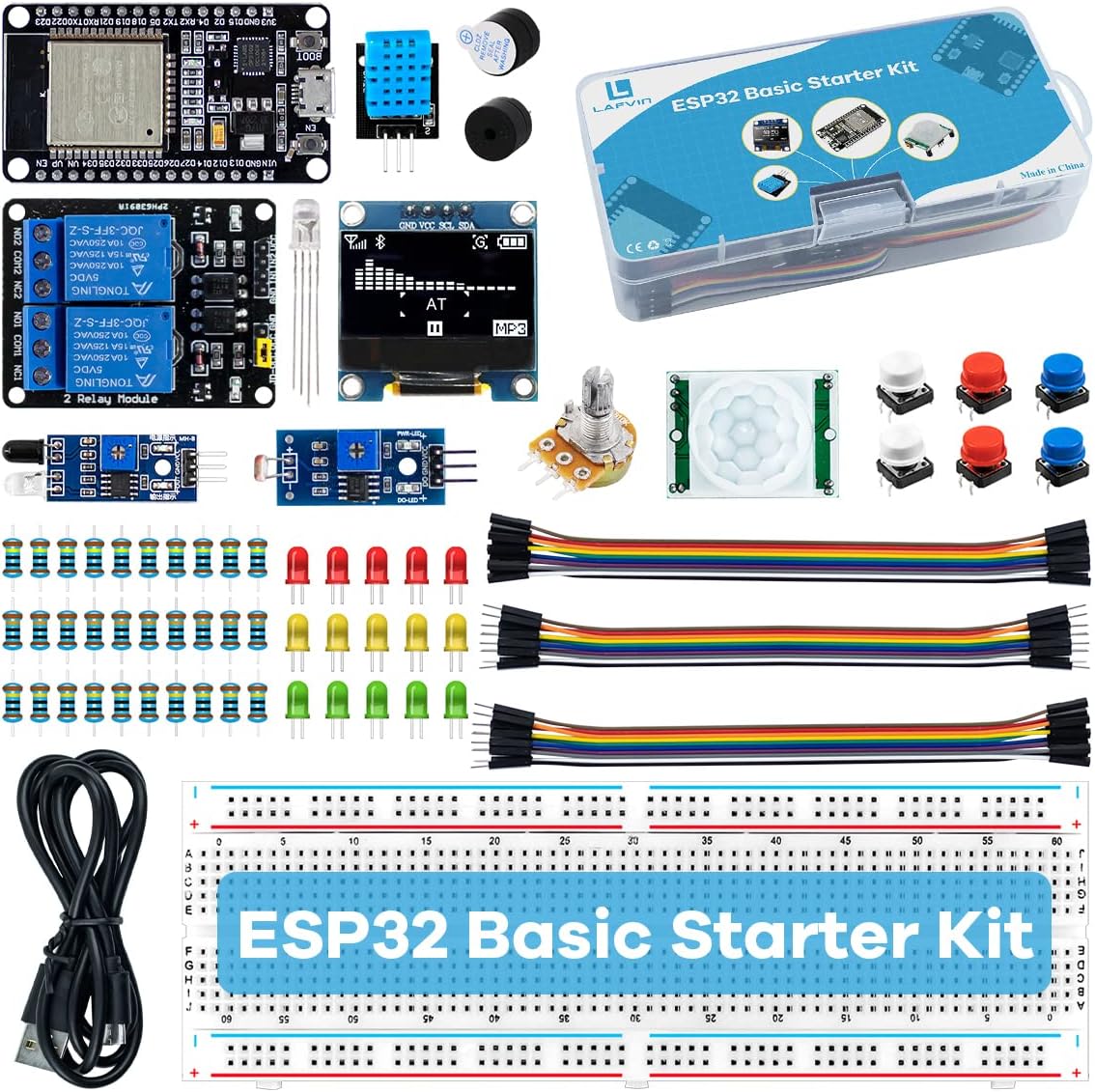
LAFVIN Basic Starter Kit
4.5Editor score
Affordable entry-level price
Arduino IDE compatible
Includes essential sensors
Explore the top ESP32 starter kits for beginners and makers. This guide compares features, tutorials, and components to help you choose the best development
Choosing the right ESP32 starter kit is essential for anyone looking to dive into the world of Internet of Things and embedded systems. A good kit provides everything you need, from the microcontroller board to sensors and tutorials, ensuring a smooth learning experience without unnecessary hurdles.
We compared ten highly rated kits based on component variety, tutorial quality, board capabilities, and ease of use. Each product was evaluated to determine which offers the best value for beginners, students, and hobbyists aiming to build real-world IoT projects quickly.
Each pick below highlights unique strengths, such as camera support, sensor suites, or coding flexibility. Please note that product availability and pricing can change frequently, so verify the latest details on the product page before making your final decision.
4.5Editor score

4.3Editor score

4.6Editor score
The following table provides a side-by-side comparison of all ten ESP32 starter kits evaluated in this guide. It highlights key specifications like board type, component count, and tutorial support to help you quickly identify the best fit for your project needs.


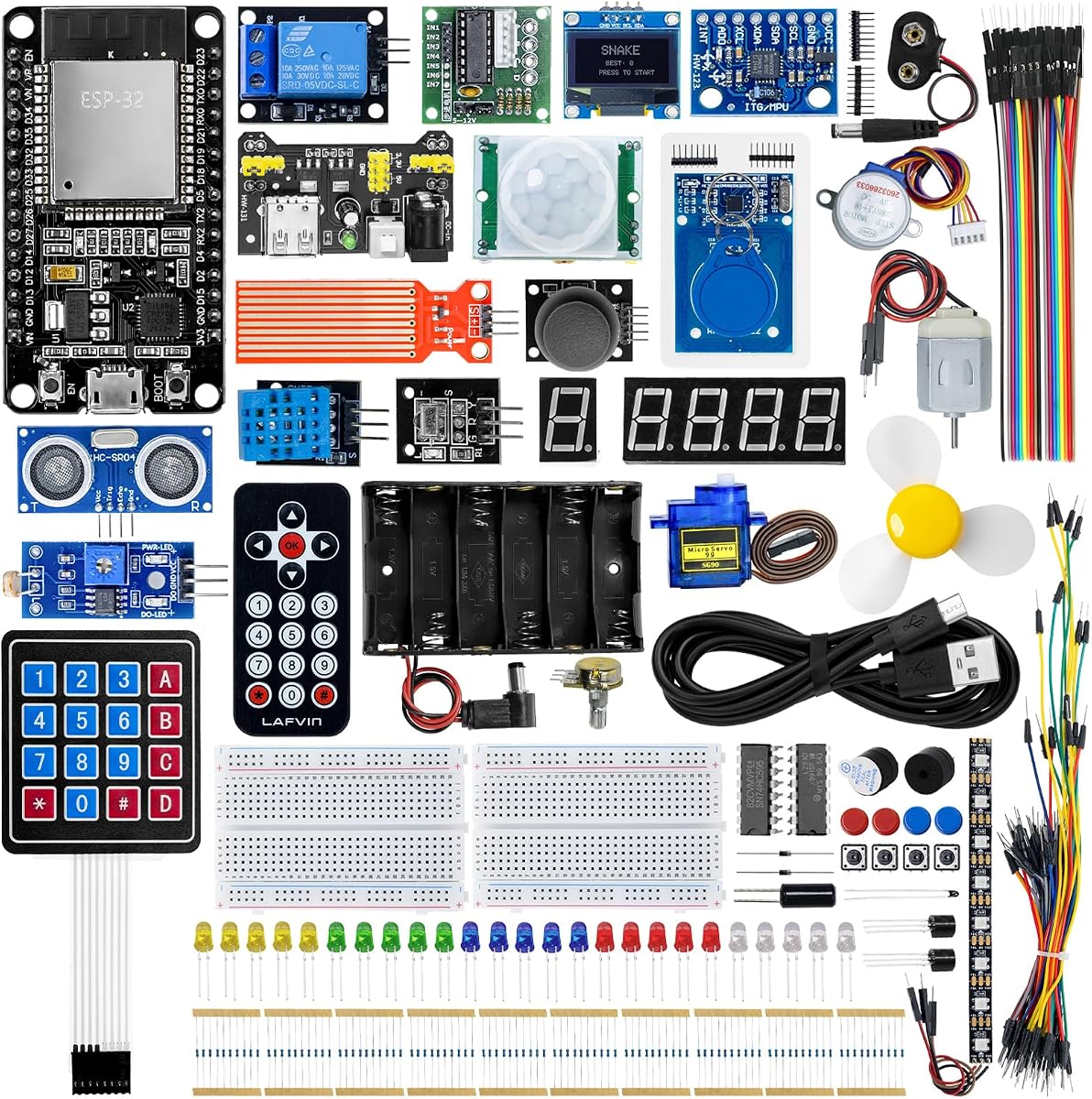


The ELEGOO ESP-32 Super Starter Kit stands out as a top choice for those entering the IoT space. With a 4.3 star rating, it offers a powerful dual-core processor and integrated connectivity right out of the box.
We may earn a commission when you buy through this link, at no additional cost to you.
This kit includes over 35 different modules, ranging from sensors to displays and motors. The accompanying online tutorial provides 30+ projects with complete code and circuit diagrams, making it ideal for hands-on learners of all skill levels.
While the price is slightly higher than basic options, the quality and support justify the cost. Users benefit from a dedicated technical support team and an active online community that helps resolve issues quickly.
If you want a reliable foundation for building smart home devices or weather stations, this kit is highly recommended. It balances component variety with instructional clarity better than most competitors in this category.
The wide range of included parts allows you to build diverse projects without needing additional purchases. This includes LEDs, buttons, OLED screens, servo motors, and keypads for versatile experimentation.
Tutorials guide you from basic circuits to advanced applications. This step-by-step approach ensures you understand the fundamentals before tackling complex IoT scenarios.
We may earn a commission when you buy through this link, at no additional cost to you.
The LAFVIN Basic Starter Kit is a perfect choice for beginners on a tight budget. It holds a 4.5 rating and provides essential tools to learn electronics and programming without breaking the bank.
We may earn a commission when you buy through this link, at no additional cost to you.
Designed for introductory use, this kit includes modules like LEDs, DHT11 sensors, and OLEDs. The tutorial includes codes and lessons that teach users how to assemble and program the basic setup effectively.
While it lacks the extensive component count of premium kits, it covers the fundamentals well. Users should be prepared to download the tutorial after receiving the goods, as no paper manual is included.
If your goal is to learn the basics of ESP32 programming and IoT control, this is an excellent starting point. It strips away complexity to focus on core skills.
At a very competitive price point, this kit removes financial barriers for students or hobbyists testing the waters of embedded systems.
The simplified component list ensures you master essential connections before moving to advanced peripherals.
We may earn a commission when you buy through this link, at no additional cost to you.
The Freenove ESP32 Camera Ultimate Kit is a powerhouse for makers interested in vision and robotics. Rated 4.6 stars, it features a dual-core processor with significant memory and an onboard camera for advanced applications.
We may earn a commission when you buy through this link, at no additional cost to you.
This kit includes 242 items and supports MicroPython, C, and Processing languages. The 795-page detailed tutorial provides step-by-step guides for 122 projects, covering everything from simple circuits to complex systems.
The main trade-off is the price, which is higher than standard kits. However, the camera module and large memory make it unique for streaming or image processing tasks that other boards cannot handle easily.
If you want to build projects that see or interact with the world visually, this is the best choice. The extensive tutorials ensure you can unlock the camera's capabilities quickly.
The onboard camera and 8MB PSRAM enable complex tasks like image streaming and object detection directly on the board.
Support for Python, C, and Processing allows you to choose the language that best fits your project or skill level.
We may earn a commission when you buy through this link, at no additional cost to you.
This kit upgrades the previous model with the ESP32-S3 board, offering Bluetooth 5 and more flash memory. It shares the high rating of 4.6 stars and includes a similar range of components and tutorials.
We may earn a commission when you buy through this link, at no additional cost to you.
The 243 items provide everything needed for comprehensive learning. The 828-page tutorial supports MicroPython, C, and Processing, giving you robust tools for visual and IoT development.
While it costs slightly more than the standard camera kit, the improved wireless capabilities are worth it for modern connectivity needs. It also features USB-OTG for direct peripheral connections.
Choose this if you need the latest features like Bluetooth 5 for better range or connection stability. It remains one of the most complete kits available for serious hobbyists.
Bluetooth 5 (LE) provides superior wireless performance for sensor networks and device communication.
USB-OTG allows you to connect devices like keyboards or drives directly to the board for expanded functionality.
We may earn a commission when you buy through this link, at no additional cost to you.
With a perfect 5.0 rating, this kit is designed specifically to help beginners explore electronics and IoT concepts. It combines an ESP32 board with essential modules for practical DIY projects.
We may earn a commission when you buy through this link, at no additional cost to you.
The kit supports wireless communication and sensor-based projects, helping learners gain practical experience with microcontrollers. It is highly suitable for STEM education and classroom activities.
While it is basic compared to the camera kits, it focuses on foundational skills. The compatibility with Arduino IDE makes it accessible for students with prior knowledge of the platform.
If you are looking for a classroom-friendly or home-school kit, this is a reliable choice. It encourages exploration without overwhelming you with too many complex options.
The 5.0 rating suggests users find it exactly what they need for learning core concepts efficiently.
Designed for education, it allows multiple students to work on similar projects with consistent components.
We may earn a commission when you buy through this link, at no additional cost to you.
This kit offers a more affordable version of the Ultimate kit while keeping the essential camera feature. With a 4.6 rating, it includes 143 items and 58 projects for learning.
We may earn a commission when you buy through this link, at no additional cost to you.
The detailed tutorial can be downloaded online, providing step-by-step guides for electronics knowledge. It supports MicroPython and C, making it versatile for different coding preferences.
If you want camera functionality but do not need 240 components, this is a great middle ground. It reduces the complexity and cost while still delivering visual project capabilities.
It is ideal for makers who want to try computer vision on a budget. The smaller component count keeps the setup manageable for beginners.
You get the camera functionality at a lower price point, making visual IoT projects more accessible.
With fewer components, the learning curve is less steep while still covering advanced visual concepts.
We may earn a commission when you buy through this link, at no additional cost to you.
This kit is unique in its focus on Wi-Fi IoT development. With a 4.4 rating, it helps users build web-based control systems and monitor sensor data via browsers on smartphones.
We may earn a commission when you buy through this link, at no additional cost to you.
It includes a variety of modules like ultrasonic sensors, RFID, servo motors, and temperature sensors. The tutorial courses guide you through creating interactive projects like smart home prototypes.
While it is not as complex as the Freenove ultimate kits, it is excellent for learning how to connect devices to the internet. The progressive projects teach communication fundamentals effectively.
Choose this if you want to build web interfaces for your hardware. It is great for hobbyists interested in networked devices and remote control applications.
The focus on creating web control interfaces makes it unique for learning networked IoT development.
Projects include smart home prototypes that let you experiment with remote access and monitoring.
We may earn a commission when you buy through this link, at no additional cost to you.
This kit stands out by including a half-size breadboard and jumper wires right out of the box. With a 5.0 rating, it simplifies prototyping significantly compared to soldering-heavy kits.
We may earn a commission when you buy through this link, at no additional cost to you.
It features common sensors like HC-SR501 motion and HC-SR04 ultrasonic. The online tutorials support both Arduino IDE and MicroPython, giving flexibility for coding styles.
The inclusion of a breadboard makes it easier to test circuits without soldering. This is great for quick experiments and learning circuit design principles.
If you want to avoid soldering in the early stages, this kit is highly practical. The breadboard support makes it ideal for iterative development and learning.
The included breadboard and jumper wires allow for immediate prototyping and circuit testing without tools.
Online resources are available for DIY projects, ensuring you can find guides even without printed manuals.
We may earn a commission when you buy through this link, at no additional cost to you.
This kit supports three programming methods, making it accessible for children and beginners. With a 4.4 rating, it offers 40+ lessons and 96 components for structured learning.
We may earn a commission when you buy through this link, at no additional cost to you.
It includes Arduino IDE, Scratch, and Python support. This allows you to start with graphical coding and move to text-based languages as you progress.
The organized components and anti-static packaging prevent confusion during assembly. It is a practical gift for teens and beginner programmers interested in STEM.
If you want to learn without coding first, this kit offers the best flexibility. The Scratch support makes it unique for educational settings.
The Scratch support lets you create projects with drag-and-drop blocks before learning complex syntax.
Tutorials are designed to connect logically, guiding you from simple circuits to complex applications.
We may earn a commission when you buy through this link, at no additional cost to you.
This kit features a flagship ESP32-S3 board with 16MB flash and an expansion board for plug-and-play sensors. It holds a 4.5 rating and offers a modular approach to hardware connections.
We may earn a commission when you buy through this link, at no additional cost to you.
The 12 sensors connect via standardized cables to dedicated ports. This eliminates complex wiring and speeds up setup for educational and development projects.
While it costs more, the convenience of modular connections is valuable. It is compatible with C++, MicroPython, and ESP-IDF for serious developers.
If you want a reliable and fast setup, this is a great choice. The expansion board simplifies the build process significantly.
The standardized cables and dedicated ports remove the need for complex wiring or breadboards.
The 16MB flash and secure boot make it suitable for professional and advanced application development.
We may earn a commission when you buy through this link, at no additional cost to you.
Selecting the right ESP32 starter kit requires careful consideration of your project goals, coding experience, and budget. This guide breaks down the essential factors to help you make an informed decision.
The heart of any ESP32 kit is the microcontroller board. Look for dual-core processors, Wi-Fi and Bluetooth connectivity. The ESP32-S3 offers newer features like Bluetooth 5 and USB-OTG which are beneficial for advanced projects.
Verify that the board supports the protocols you need for your IoT applications.
Kits range from basic sets with a few sensors to ultimate kits with hundreds of components. A higher count usually means you can build more complex projects without buying extra parts later.
Ensure the included sensors match your interests, such as cameras for visual projects or temperature sensors for environmental monitoring.
Detailed tutorials are vital for beginners. Look for kits with step-by-step guides, schematics, and code examples. Online tutorials are common, so ensure they are well-maintained and easy to access.
Choose a kit with strong community support to help troubleshoot issues when you get stuck.
Some kits focus solely on C/C++ via Arduino IDE, while others support Python or Scratch. Select a kit that matches your learning path. Python is great for beginners, while C offers more control for advanced tasks.
Check if the kit provides libraries or frameworks for your preferred language to simplify coding.
Breadboards and jumper wires are essential for testing circuits. Some kits include them, which saves money and simplifies initial experiments. If not, you will need to source them separately.
Kits with expansion boards or plug-and-play ports offer even greater flexibility for rapid prototyping.
Prices vary significantly. Basic kits can cost under twenty dollars, while ultimate kits may exceed sixty. Determine your budget early to filter options that provide the best value.
Consider the long-term value. A slightly higher upfront cost for a comprehensive kit can save money in the long run.
If you need visual capabilities, choose a kit with an onboard camera. These kits often include SD card slots for storage and memory for image processing. They are specialized for robotics and monitoring tasks.
Standard kits do not include cameras, so verify specific hardware needs before purchasing.
For students and classrooms, look for kits labeled as STEM learning. These often have structured curriculums and support multiple coding languages. They are designed to teach concepts rather than just build hardware.
Check if the kit includes materials suitable for group work or educational curricula.
Start by setting up your development environment. Install the Arduino IDE or MicroPython compiler on your computer. Connect the ESP32 board via USB and verify it is recognized by your system drivers.
Keep your components organized in anti-static containers. The small sensors and connectors can be lost easily. Labeling bins or using the provided storage case helps maintain order during experiments.
Regularly update your firmware and libraries. New features and security patches are released frequently. Keeping your software up to date ensures your projects remain stable and secure.
Yes, most kits are designed specifically for beginners. They include tutorials and components to guide you through the basics of electronics and programming. Starting with a kit removes the guesswork of selecting individual parts.
Many modern kits focus on plug-and-play components that do not require soldering. Some come with breadboards for temporary connections. Soldering is only necessary for building permanent circuits, which is an optional step.
The ESP32-S3 is a newer version with improved connectivity like Bluetooth 5 and USB-OTG support. It also has more memory in some configurations. Choose S3 if you need these modern features.
Most kits provide tutorials as downloadable PDFs that can be saved offline. However, some rely on online documentation. It is a good idea to download the guides immediately upon receiving your kit.
Yes, these kits are ideal for home automation projects. You can build smart switches, sensors, and controllers that connect to your home Wi-Fi network to monitor and control devices remotely.
Most kits support C++ via Arduino IDE. Some also offer MicroPython or Scratch. Check the specific product description to confirm which languages are officially supported for easier coding.
We have reviewed ten excellent ESP32 starter kits ranging from basic beginner sets to advanced camera-enabled options. Each kit offers unique strengths depending on your project goals and coding preferences.
For most beginners, the ELEGOO or LAFVIN kits offer the best balance of price and support. If you need advanced features like camera vision or Bluetooth 5, consider the Freenove or Lonely Binary options.
Prices and availability change frequently on Amazon. Always check the current product details and customer reviews before finalizing your purchase to ensure you get the best kit for your needs.