Rad Triage 50
4.4Editor score
Fits in wallet
No batteries needed
Military-grade tested
This expert guide compares the top ten radiation dosimeters available in October 2026, evaluating accuracy, battery life, and portability for personal safety
Radiation dosimeters are essential tools for anyone concerned about exposure to ionizing radiation in their daily environment or professional workspace. These devices provide critical data on radiation levels, helping users make informed decisions about safety and health risks.
We compared ten leading dosimeter models based on sensor accuracy, battery longevity, display clarity, and feature sets. Our analysis focuses on real-world usability, data logging capabilities, and overall value for both casual users and technical professionals.
Each pick highlights key strengths and potential limitations to help you find the right device for your specific situation. Please note that product availability and pricing may change frequently, so always verify details before purchasing.
4.4Editor score

4.6Editor score

4.6Editor score
This table provides a side-by-side comparison of all ten dosimeter models reviewed in this guide, highlighting their unique specifications and core functionalities for easy reference.


The GQ GMC-800 stands out as a top-tier dosimeter with its robust feature set and high accuracy. It consistently earns high marks for its reliable detection of beta, gamma, and X-ray radiation in various environments.
We may earn a commission when you buy through this link, at no additional cost to you.
Its large color LCD display makes reading data effortless even in bright sunlight, while the five different alarm types ensure you are notified instantly if radiation levels exceed safe thresholds. The device also supports extensive data storage for long-term monitoring.
While it is pricier than basic models, the precision and compliance with US national standards justify the investment for serious users. Calibration is straightforward, and the rechargeable battery offers practical convenience for daily use.
This device is ideal for professionals, researchers, or anyone needing dependable radiation monitoring. Its balance of accuracy, usability, and advanced features makes it our primary recommendation for most users.
The device allows for data storage up to ten years and supports online sharing via open protocols, enabling detailed trend analysis over time.
With visual, audio, vibration, and voice alarms, it accommodates users with varying sensory needs, ensuring critical alerts are never missed.
We may earn a commission when you buy through this link, at no additional cost to you.
The GQ GMC-300S offers a practical balance of features and price for users seeking reliable radiation monitoring without the highest-tier cost. It provides solid accuracy and essential data logging capabilities for personal safety.
We may earn a commission when you buy through this link, at no additional cost to you.
Its ability to log data every second into internal memory allows for precise tracking of radiation exposure over time. The included free PC software makes it easy to download and analyze historical data on a computer.
While it lacks the expansive color screen of higher models, its compact design fits well in field applications. The rechargeable battery ensures you can use it for extended periods without needing disposable replacements.
This model is well-suited for hobbyists or occasional users who need trustworthy data. It delivers strong performance in the mid-range category, making it a smart choice for budget-conscious buyers.
The graph mode allows you to visualize radiation trends, helping you understand fluctuations in your environment more clearly than raw numbers alone.
A rechargeable battery design reduces long-term waste and cost, providing reliable power for extended monitoring sessions without interruption.
We may earn a commission when you buy through this link, at no additional cost to you.
This version of the GQ GMC-800 represents the latest iteration of a proven design, maintaining high standards for radiation detection. It retains the popular features of the original while ensuring compliance with updated safety norms.
We may earn a commission when you buy through this link, at no additional cost to you.
Users benefit from the same reliable color LCD and five alarm types, ensuring consistent performance in critical situations. The device remains lightweight and portable, making it easy to carry during fieldwork or travel.
Although it is similar to the previous model, the upgrade ensures you receive the most current firmware and calibration standards available. This longevity in design offers peace of mind regarding future compatibility and support.
It remains a top recommendation for those who value brand consistency and reliability. If you prefer the latest manufacturing standards, this model is a dependable choice for comprehensive radiation monitoring.
Light, thin, and anti-drop construction makes it easy to carry in a pocket or bag for continuous protection wherever you go.
Meeting US national standards like NIST and NRC ensures that the readings are trusted and aligned with regulatory requirements.
We may earn a commission when you buy through this link, at no additional cost to you.
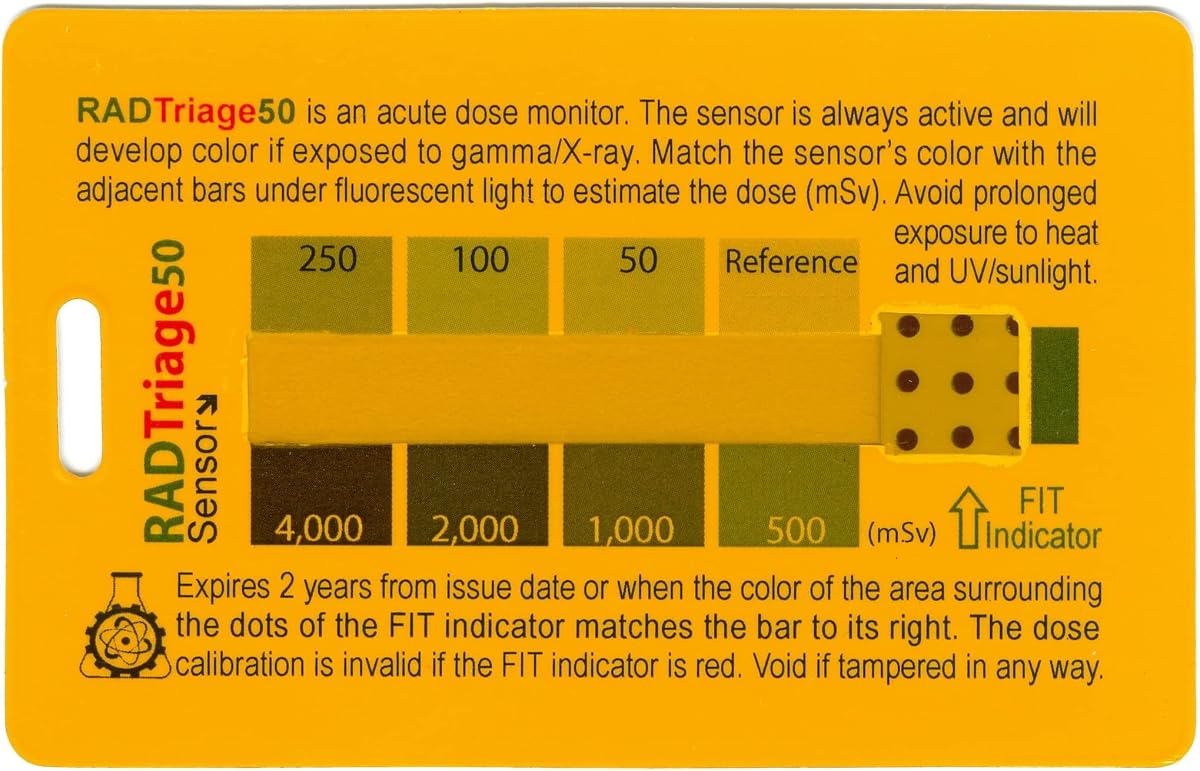
The Rad Triage 50 is a unique, compact solution designed to fit in a wallet or pocket for emergency preparedness. It uses a passive sensor that requires no batteries, making it ideal for long-term storage.
We may earn a commission when you buy through this link, at no additional cost to you.
It provides immediate detection of beta, gamma, and X-ray radiation through color-coded markings, allowing quick assessment of exposure without electronic components. Its approval by the US Dept of Homeland Security adds a layer of trust.
While it lacks digital data logging or screens, it serves a specific niche for critical safety. If you need a reliable, always-ready device for emergencies rather than detailed analysis, this is an essential tool.
This model is perfect for preppers, first responders, or anyone needing a backup safety measure. Its affordability and simplicity make it a great addition to any emergency kit.
The shelf life can be extended up to ten years by storing it in the freezer, ensuring long-term reliability for emergency situations.
Impervious to EMP blasts and field-tested, it remains functional even in extreme conditions where electronic devices might fail.
We may earn a commission when you buy through this link, at no additional cost to you.
The APOWER RD-3 is a versatile handheld detector that combines ease of use with practical safety features. It detects beta, gamma, and X-ray radiation with a solid range suitable for most environmental monitoring tasks.
We may earn a commission when you buy through this link, at no additional cost to you.
Its triple alarm system ensures you are alerted through sound, light, and screen changes if radiation levels become hazardous. The LCD color display is easy to read, and the device supports custom settings for different users.
Battery life is a standout feature, offering up to eight days on a single charge with the alarm sound off. This makes it a reliable tool for longer monitoring sessions without frequent interruptions.
Ideal for homeowners, travelers, or hobbyists, this model provides strong value. It is a great middle-ground option for those who want digital features without a high price tag.
Users can adjust alarm thresholds and measurement units to match their specific needs or local regulations for accurate monitoring.
Historical data is automatically stored after each session, allowing you to track changes in radiation levels over time easily.
We may earn a commission when you buy through this link, at no additional cost to you.
The AEGTEST Radar-5633 offers a simplified approach to radiation detection with a clear, all-in-one display. It avoids complex menu navigation, showing multiple units on a single screen for immediate readability.
We may earn a commission when you buy through this link, at no additional cost to you.
Its semiconductor sensors provide fast detection rates, making it useful for quick checks in various environments. The battery life is impressive, lasting up to eighteen days with sound turned off, which suits infrequent users.
However, it scores slightly lower on accuracy compared to premium models. While it serves well for casual monitoring, professionals might require more robust calibration and sensitivity for critical applications.
This device is best for those seeking an affordable and straightforward tool. If you need a basic detector for home or occasional field use, it delivers good value for the price.
The menu design is feature-rich yet intuitive, allowing you to customize settings without spending too much time in the setup.
Visual and audible alerts activate even when the screen is in sleep mode, ensuring you remain aware of hazards without checking the device.
We may earn a commission when you buy through this link, at no additional cost to you.
The HFS-50-CsI stands out with its CsI scintillator sensor, offering superior precision and stability over traditional Geiger tubes. It is designed for users who need high-level accuracy and reliable data in complex environments.
We may earn a commission when you buy through this link, at no additional cost to you.
Its dynamic waveform display allows you to see real-time fluctuations in radiation levels, providing deeper insight into environmental changes. The battery life is exceptional, lasting up to seventy days in sleep mode for continuous long-term monitoring.
This model is more expensive, but the advanced features justify the cost for professional use. It includes a telescopic rod for safe distance measurement, making it ideal for lab or industrial applications.
If you prioritize data accuracy and sensor quality, this is the top choice. It is perfect for lab technicians, researchers, or anyone managing radiation risks in a professional setting.
The CsI scintillator sensor is more resistant to interference, providing stable and reliable readings even in challenging conditions.
A telescopic rod helps maintain a safe distance from radiation sources, enhancing user safety during close-range inspection tasks.
We may earn a commission when you buy through this link, at no additional cost to you.
The GQ GMC-500Plus is a specialized device designed for users who want to contribute to global radiation monitoring networks. Its ability to submit data to unlimited servers makes it a powerful tool for crowdsourced safety data.
We may earn a commission when you buy through this link, at no additional cost to you.
Dual Geiger tubes extend the detection range significantly, allowing it to handle higher radiation levels than standard devices. The large LCD display and audio output ensure you can read and hear data clearly in noisy environments.
While it is a slightly older model, its unique server logging feature remains unmatched. It is ideal for community scientists or organizations needing to aggregate data from multiple locations worldwide.
This model is perfect for those involved in global monitoring initiatives. If sharing data for public safety is a priority, this device offers a distinct advantage over competitors.
The device can automatically submit data to any server worldwide, facilitating real-time sharing and analysis of radiation trends.
Two independent Geiger tubes increase detection range and accuracy, allowing you to monitor higher radiation fields effectively.
We may earn a commission when you buy through this link, at no additional cost to you.
The MOESAPU FS5000 features a distinct audible click sound that corresponds to detected particles, adding an intuitive layer to monitoring. Its live graph tracking helps visualize exposure trends effectively over time.
We may earn a commission when you buy through this link, at no additional cost to you.
With a runtime of up to thirty days on a full charge, it is suitable for long-term monitoring without frequent recharging. The clip design makes it convenient to attach to a shirt or pocket for hands-free use.
It excels in detecting low-dose radiation in antique collections or home renovations where uranium glass may be present. The haptic alerts ensure you are warned even if you are not looking at the screen.
Ideal for collectors or renovators, this model offers specialized value. Its ability to turn invisible radiation into sound makes it a user-friendly tool for hobbyists and casual monitors.
The live graph allows you to see real-time dose rate changes, helping you identify spikes or trends instantly.
You can set specific thresholds for audio, visual, and vibration alerts to match your safety preferences and environment needs.
We may earn a commission when you buy through this link, at no additional cost to you.
The Soogua Geiger Counter is a versatile tool for general detection across various environments, including food or material inspection. Its fast response time allows for quick identification of potential radiation sources.
We may earn a commission when you buy through this link, at no additional cost to you.
With a built-in GM sensor and color LCD display, it provides clear readings for beta, gamma, and X-rays. The four alarm modes ensure you are notified through sound, vibration, light, or screen alerts when limits are exceeded.
It supports multiple custom settings like brightness and language, making it accessible to a wide range of users. The high capacity battery ensures you can use it for long periods without needing to recharge.
This model is suitable for diverse applications like geological surveys or home safety checks. If you need a reliable detector for occasional use with a focus on flexibility, it is a solid candidate.
Its design supports various uses from home improvements to outdoor environments, making it a flexible tool for general monitoring.
The four alarm modes ensure you receive immediate warnings through multiple channels for maximum safety awareness.
We may earn a commission when you buy through this link, at no additional cost to you.
Choosing the right dosimeter depends on your specific needs, environment, and budget. Understanding key factors will help you select a device that offers reliable protection and accurate data.
Different sensors like Geiger-Muller tubes or scintillators offer varying levels of accuracy and sensitivity. Scintillators are generally more precise and better for low-level radiation, while Geiger tubes are robust for general use.
Select a sensor that matches your primary use case, whether for casual checks or professional analysis.
Ensure the device can detect the types of radiation you are most concerned about, such as Beta, Gamma, or X-rays. Some models cover a wider energy spectrum than others.
Check the energy response range to confirm it aligns with the potential hazards in your environment.
Features like internal memory and PC software allow you to track radiation trends over time. This is crucial for understanding cumulative exposure rather than just instantaneous readings.
Look for devices that support long-term storage and easy data export if you need to review historical safety data.
A clear display is essential for quick reading in different lighting conditions. Color LCDs offer better contrast than monochrome screens, but screen size matters for visibility.
Choose a device with a readable screen that allows you to monitor data comfortably without straining your eyes.
Continuous monitoring requires reliable power. Rechargeable batteries with long runtimes reduce the hassle of frequent charging or replacements during critical times.
Prioritize models with efficient power management if you plan to use the device for extended periods outdoors.
Multiple alarm types such as audio, visual, and vibration ensure you are alerted even if you cannot see the screen. Some devices offer adjustable thresholds for custom alerts.
Ensure the alarm is loud and clear enough to be noticed in noisy environments to maintain safety.
Compact and lightweight designs are easier to carry for daily monitoring or fieldwork. Some models even fit in a wallet for emergency preparedness.
Consider how much weight you can carry if you need to use the device frequently on the go.
Models compliant with national standards like NIST or NRC offer higher accuracy and trustworthiness. Calibration frequency and cost should also be considered for long-term use.
Choose a device that meets recognized safety standards to ensure your readings are valid and reliable.
Always calibrate your device according to the manufacturer's instructions before first use. This ensures that the readings are accurate and reliable for your safety.
Keep the device clean and dry, avoiding extreme temperatures that could damage the internal components. Store it in a protective case when not in use to prevent accidental drops.
Regularly check the battery level and recharge or replace it as needed. Review historical data periodically to understand trends and adjust your safety measures accordingly.
A dosimeter measures the dose of ionizing radiation a person or environment is exposed to. It helps monitor safety levels to prevent harmful exposure over time.
Accuracy varies by model, with professional devices offering higher precision. Look for models compliant with standards like NIST for the best reliability.
Most modern models detect beta, gamma, and X-rays. However, some specialized devices might focus on specific types, so check the specs before buying.
Battery life ranges from a few days to weeks depending on usage. Rechargeable models often last longer and are more environmentally friendly.
Yes, many devices feature internal memory and support downloading data to a computer. This allows for tracking exposure over extended periods.
Yes, using a dosimeter at home is safe and can help you monitor environmental radiation levels. It provides peace of mind regarding potential exposure.
Calibration frequency depends on usage and model. Professional devices may need regular calibration, while basic models can go longer between checks.
A dosimeter measures cumulative exposure over time, while a Geiger counter measures instantaneous radiation levels. Many modern devices combine both functions.
We have reviewed ten top dosimeter models ranging from budget-friendly emergency tools to high-precision professional devices. Each offers unique strengths tailored to different monitoring needs.
Prioritize accuracy and battery life if you need long-term monitoring. For emergency kits, a simple, battery-free option like the Rad Triage 50 provides essential peace of mind.
Always verify the latest pricing and availability before purchasing. Safety equipment is an investment in health, so choose a model that fits your specific safety goals.